

Daniel K. Ludwig was the very model of a self-made man.
He left school after the
eighth grade and worked in shipping-related jobs before striking out on his own
to ship molasses around the Great Lakes. He was then nineteen.
Before he was done (he
died in 1992 at the age of 95) he was the sole owner of National Bulk Carriers,
one of the largest shipping companies in the United States.

He pioneered the construction of supertankers. He expanded
into banking, cattle ranching, real estate, mining and insurance. He founded a chain of luxury hotels in
Mexico, Bermuda and the Bahamas, had operations in the Americas, Africa,
Australia and the Middle East and was, at one point, the richest man in America,
#1 on the Forbes 400 list when it was
first published in 1982.
He was a philanthropist,
too, who donated more than one billion dollars of his fortune researching cures
for cancer.
But he maintained a low
profile, stopped talking to the press in the 1950’s and few Americans ever heard of him.
Not so in Brazil. Here Ludwig
is famous, his name inextricably linked to one of the most ambitious industrial
projects ever undertaken in the history of man. And even more remarkable for where it was undertaken: in the heart of
the Amazon Rainforest.
The Jari Project began
in 1967, when Ludwig made the biggest land purchase ever registered to a private individual. It was larger than the American State of Connecticut, and spread
out, about equally, on either side of the Jari River, the stream that separates
the current-day States of Pará and Amapá.
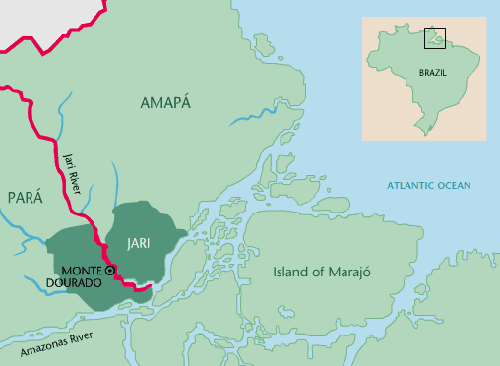
Back then, though, it
was all federal land – and it was from the Brazilian Federal Government that
Ludwig bought it.
Initially, Ludwig’s plan
was to exploit his new acquisition by ranching and farming, but he soon
expanded it to include mining and the manufacture of cellulose, for which he
intended to plant fast-growing trees, pulping and processing them right there in situ.
For that he had to construct
two factories, one for manufacturing the product and one to generate electricity.
And he had to undertake a vast
project to develop the infrastructure.

The factories were built
in Japan, and they were designed to float, so they could be towed, by sea and river, to their final destinations – a distance of over twenty five thousand
kilometers.

The infrastructure
included a railroad, a port, more than nine thousand kilometers of roads, and a
town (Monte Dourado on the map above). The latter occupied an area of sixteen
square kilometers and included housing, schools, clubs, shops, a police station,
a hospital and an airport.
It took more than a
decade to do it all. In the process, Ludwig’s town grew to more than
thirty-thousand people.

But then the authorities
in Brasilia began to fear, as they put it, loss
of sovereignty.
The truth of the matter
was that Ludwig, a foreigner, had simply become too powerful for the
politicians to stomach.

So they played the
nationalist card. (The title, above, which appeared on the cover of a magazine
of the time, reads, The American Invasion.)
Ludwig, frustrated and
annoyed, abandoned the project in 1982. He estimated that he’d sunk, in the dollars
of those days, almost one point two billion into it.
He got some back, but
only a small part. After all, who could afford to buy it?
Finally, in 2000, the
factories were bought by the Orsa Group ( http://www.grupoorsa.com.br/en/ ) a company dedicated to sustainable development. And
now, Ludwig’s factory is profitably producing vast quantities of cellulose –
and doing it in a way that enabled them, in 2004, to be certified by the Forest
Stewardship Council.
( http://www.fsc.org/
).
A happy end to a somewhat unhappy story - and all thanks to the vision of an American entrepreneur.
A happy end to a somewhat unhappy story - and all thanks to the vision of an American entrepreneur.
Leighton -
Monday





Very interesting! There must be something in the name "Ludwig" that drives some to take on vast construction projects, be they Bavarian castles or Brazilian communities.
ReplyDeleteThis man must have been fascinating, and I'm glad the structures are in use, employing people, without the feeling of invasion :) I am enjoying your posts so much. The news here is hopelessly Eurocentric. Which I guess is better than no news at all.
ReplyDeleteI work for the Company Mr. Ludwig started. After he passed away he left all his money to Cancer Research...he was a great businessman..but with Jari he lost alot of money.
DeleteI lived in Monte Dourado for a few years in the 70s when my father worked on the engineering for the cellulose plant. Very interesting experience as a youngster.
DeleteMy father worked for The Jari Project as well from 1978-80. We lived in Monte Dourado. I was 8 years 8 years old when we arrived. I loved it there. Many fond memories. Attended the American school.
DeleteJe comprends bien mieux le roman : Le Roi vert.
ReplyDeleteG C
What a great article summarizing this amazing project. I lost track of it after my relative died on the project just after the arrival of the mills from Japan and their successful installation. I am gratified to see that it's being managed in a sustainable way. It's comforting to know that this project, which was a great experience for him to work on and be a part of is still going on.
ReplyDeleteMy father worked on the Jari Project. Can I ask who your relative was that passed away? It was a very exciting time. I have fond memories. I was 8 years old when my father moved us to Monte Dorado to work for DK and Jari.
DeleteAnd it is lovely for us to know that the posts our colleague Leighton left here are still enjoyed by our readers. Leighton Gage, the author of this post, passed away just ten days ago. We lose our loved ones, but their work goes on. There is great comfort in that. Leighton wrote with great sensitivity about Brazil. You should have a look at his website and learn about his books. I hope you will. http://www.leightongage.com/Leighton_Gage/HOME.html
ReplyDeleteI still work for The Ludwig Group, which was the company that Mr. Ludwig founded, originally it was National Bulk Carriers, Inc. He left his money to cancer research. He was an amazing man...
ReplyDeleteDoreen, did you live in Monte Dourado, Brasil?
DeleteI lived there as an 8 year old. Many fond memories that seem like yesterday. Did you work directly with DK? I would like to know more. angela@boardmanvideo.com
I was contracted by Rose Gomes from National Bulk Carriers of New York as the Superintendent Mechanical Maintenance for the Jari project in Para Brazil. The last two years were spent preparing the project for the 'hand back' to the National Brazilian Government.
ReplyDeleteAlthough the Mr Ludwig was treated badly by the Brazilian Government he was also deceived by his high level Officers on site who misappropriated Millions of Dollars worth of valuable equipment and fuel supplies.
As the investigations commenced into this Grand Theft the administration offices were 'razed' to the ground and several North American Mangers and a Superintendent left the very next day, Death threats were so prevalent that we carried the 'Brazilian Special 410 gauge, double barrel shot guns' with us at all times. It truly was 'corruption personified'. Mr Ludwig's fuel and tires were found in Brazilian navy vessels, contractors earth moving and contractors logging trucks, (Diesel fuel had been dyed and tires had been internally stamped for identification as they arrived on site).
Mr Ludwig was held in very high esteem by most of those who were employed in his manifold operations.
My father was one of D.K.'s main accountants/PR director/Friend (Ralph Leach) from the 60's to the Late 70's. I remember my father going to Brazil, and Venezuela a lot back then. I have many fond memories of Bermuda and the Princess Hotel and its huge arch windows. I even remember our home on the isles of Bermuda in Garth Owen Estates. It's name was the "Meadowlark. I even remember the building of Westlake Village just NE of Los Angeles in the 70's. Thank you to the Author of this article for allowing me to revisit some really happy times in my past. :)
ReplyDeleteScott Leach
scotteleach@att.net
Wow this is awesome..I worked for nyc in 1984 and as the name has chaNged after Mr Ludwig passed away and heft his money to cancer research it is now call the Ludwig institute for cancer research. I hAve been here 32yrs Nd remember when Westlake village was but and the jari project and many of my old it'd and nyc co-workers fondly still remember Mr Ludwig. I'm glad to see fond memories of such amazing man
Deletethis is a question maybe you can answer how many floors in Burlington house did his main company use/have ?
DeleteToddy Ivanovo, I am very sad to say that Leighton Gage, author of this article and founder of or blog has passed away. We cannot help you with your question.
DeleteThis SITE is information is so nice soft,
ReplyDeleteAFRICA REAL ESTATE
Good article. I was there early on helping set up timber harvesting operations and providing equipment. Good to see it is a sustainable operation employing so many people.
ReplyDeleteI worked for one of his legal counsel in 1979. I had been told he was our most important client and that if he called I was to "personally fly his call to his attorney through the air". I was the receptionist at that firm.
ReplyDeleteWow! My father worked on the Jari Project in the mining phase. I spent my early childhood in Monte Dourado. It was an incredible time, with incredible people. So many memories! I didn’t know the significance of that phase of my life until I read this article. To me it was just my childhood-ages 4-7. We lived in three different houses while we were there, the last one being one of the first group built in the town. It was a plantation house on stilts on the bluff overlooking the river, with nothing but jungle across the road from our house. We still have home movies. My brother was born there. Just wow, thank you! Glad to know that the area is now sustainable.
ReplyDeleteI am amazed to come across this thread. I too lived in Monte Dourado in 1974-75, when it was still a place where you could hear monkeys chattering right outside your window. My father, who was an engineer, built the processing plant for the (profitable) off-shoot of the central Jari timber project. Caulim da Amazônia (CADAM) mined and processed the large deposit of Kaolin clay found in the Jari territory. Years later, as a NY investment banker, I arranged a large financing package for this entity and had the pleasure of traveling back to Monte Dourado to sign the financial transaction. At the time, the then current managers of CADAM inscribed a plaque at the plant in honor of my father. It was a very nice gesture to acknowledge his contribution so many years ago, and such a pleasure to see the progression of Monte Dourado.
ReplyDeleteThis is Christine! You must have been my neighbor!! I lived on the last plantation house overlooking the Jari River.
ReplyDelete